Scotland-wide · Solar inverter specialists
Your System Has Stopped Generating. We Help Get It Running Again.
Specialist solar inverter diagnosis, repair and replacement across all of Scotland.
Quick answer
If your solar panels have stopped producing power, the inverter is the most likely cause. Most inverters last 10 to 15 years, far less than the panels. We diagnose the fault, repair it where we can, or replace the inverter like-for-like or with a battery-ready hybrid, and we handle the DNO paperwork.
Last updated: 1 November 2026
No-obligation quote
Want us to call you back?
Tell us what is happening and we will call you back.
- Installed through our MCS-certified partners
- Interest-free credit up to £30,000, subject to status.
- Covering homes across all of Scotland
- DNO paperwork handled for you
What are the key facts?
- A like-for-like string inverter replacement in Scotland costs £800–£1,500 fitted
- Typical inverter lifespan is 10–15 years; panels last 25–30 years
- We handle all DNO notification (G98 and G99) with SP Energy Networks and SSEN
- Feed-in Tariff and SEG payments stay valid when the replacement is done correctly
- We install through MCS-certified partners across all of Scotland
- Interest-free credit up to £30,000, subject to status
- Same-week diagnosis available — call 0141 230 0198
Last updated: 1 November 2026
Short answer
A like-for-like string inverter replacement in Scotland costs £800–£1,500 fitted, takes 3–5 working days, and protects your Feed-in Tariff. We handle DNO notification. Call 0141 230 0198 for same-week diagnosis.
Price range source: installer quotes and manufacturer trade price lists, checked October 2026.
Self-diagnosis
How can you tell it is the inverter before paying for a visit?
Not every generation fault is an inverter fault. Check these first and save yourself a call-out fee.
Use the step-by-step fault checker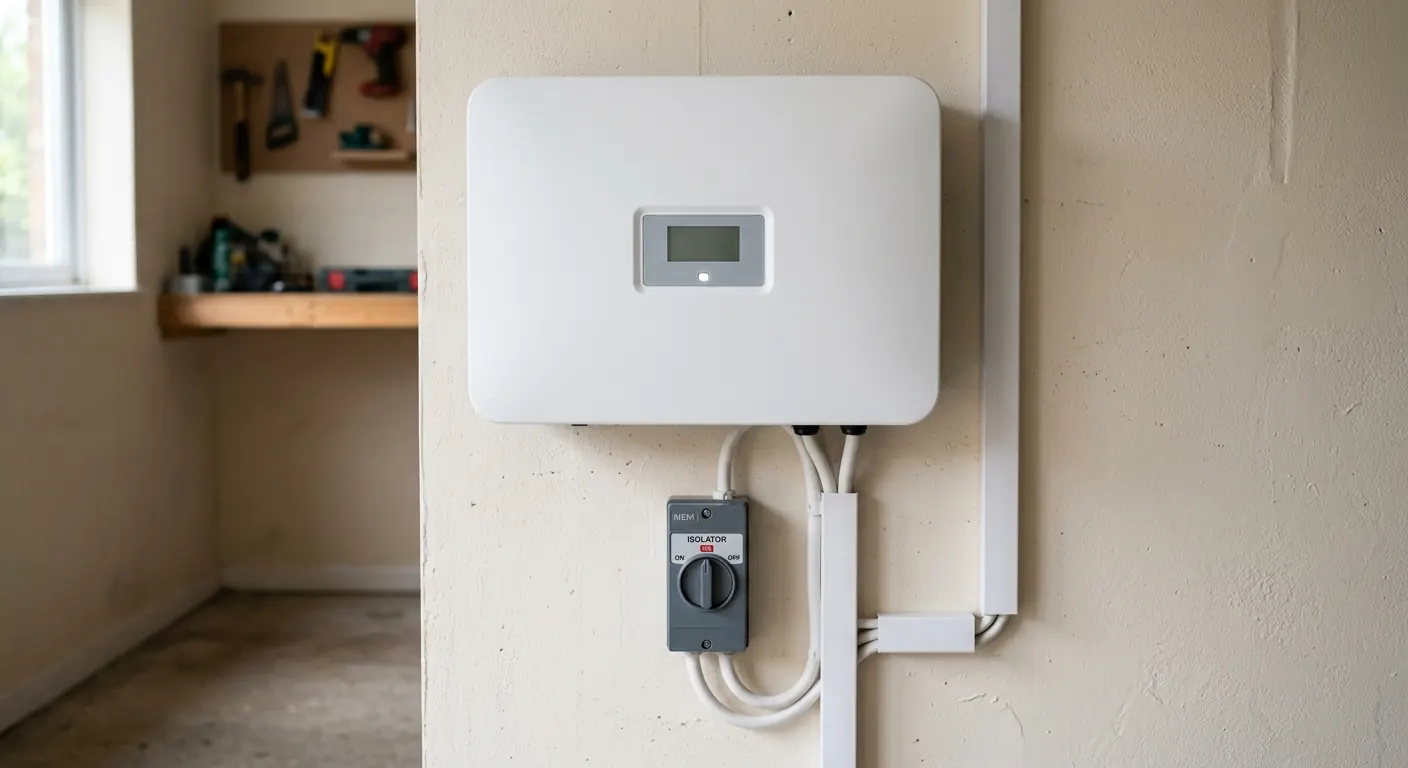
Signs it IS the inverter
- Red fault light or no lights at all on the inverter display
- Display shows 0W generation in full daylight
- Inverter making a clicking, buzzing or humming noise
- Error code on screen (earth fault, isolation fault, grid fault)
- System worked yesterday — nothing has changed on the roof
Signs it is NOT the inverter
- Generation meter still counting up (export meter issue, not inverter)
- Tripped AC isolator or MCB at the consumer unit — reset and monitor
- DC isolator on the roof turned off (check after storms or roof work)
- Partial shading or debris on panels (generation low, not zero)
- Smart meter not showing export (meter fault, not inverter)
The facts
Why does the inverter fail before the panels?
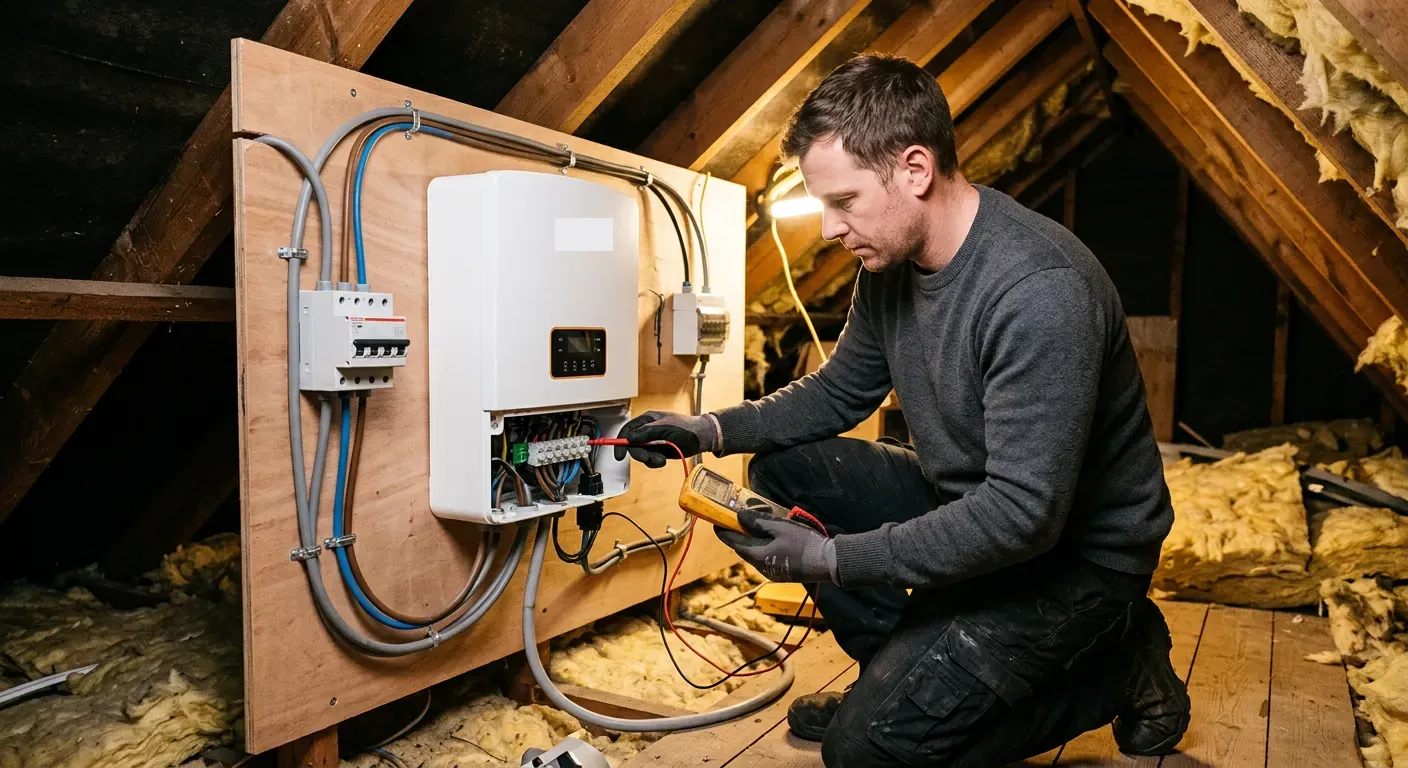
Solar panels are solid-state with no moving parts — warranted 25 years, expected life 30+. The inverter contains capacitors, fans, and power electronics that degrade with heat cycling. If your system was installed 2010–2015 under the Feed-in Tariff, the inverter is now in its failure window.
10–15 yrs
Typical inverter lifespan
25–30 yrs
Typical panel lifespan
2010–2015
Peak FIT installs now hitting inverter failure
Your options
Like-for-Like, or Upgrade to Hybrid?
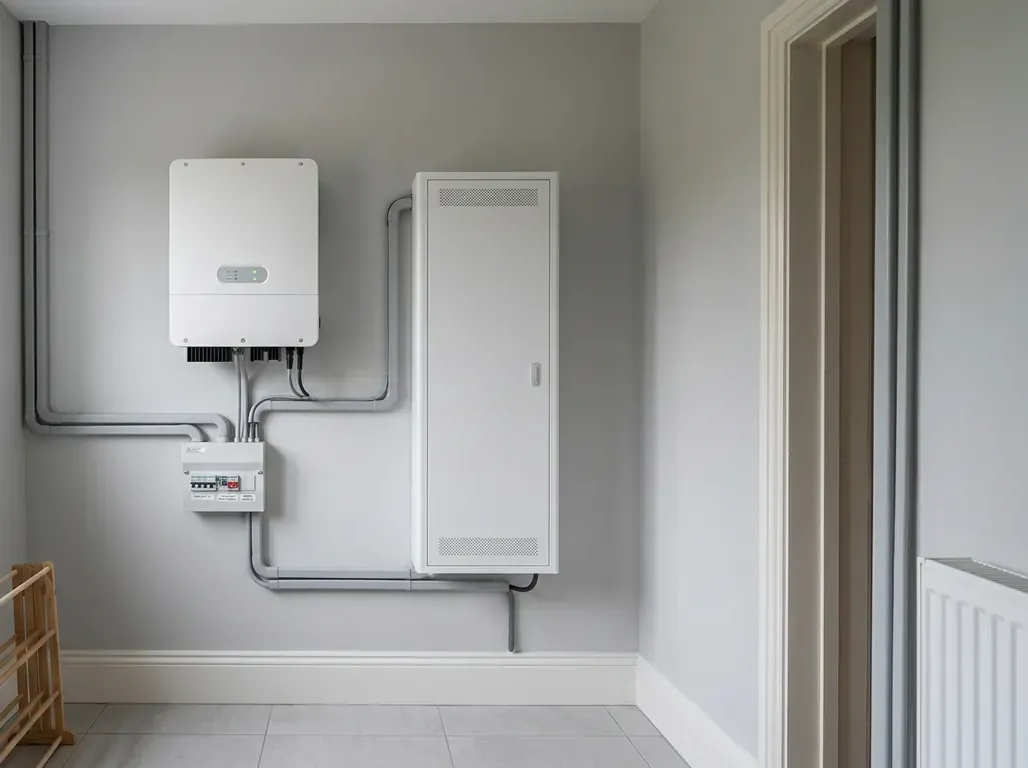
An inverter replacement is the natural moment to consider adding battery storage. A hybrid inverter handles both solar and battery — but it is not always the right choice.
Like-for-like string inverter
- Fastest option — often same-day once the part arrives
- Lowest cost: typically £800–£1,500 installed
- No change to your FIT/SEG arrangement
- No additional DNO notification if same rating and type
- Right choice when the system works well and you do not want battery
Worth considering
Hybrid inverter (adds battery capability)
- Replaces the inverter AND adds battery readiness in one install
- Higher cost: typically £1,500–£3,000 for inverter alone, battery separate
- May require G99 application if total capacity exceeds 3.68 kW per phase
- FIT arrangements need written notification to your supplier
- Right choice when you were already considering battery storage
Price ranges: installer quotes and manufacturer trade price lists, checked October 2026.
If you are weighing up battery storage alongside your inverter swap, our companion site on home battery storage walks through the options. To see the wider picture on solar costs and export payments across Scotland, the energy bills guide breaks down the numbers. If spreading the cost matters, paying monthly with interest-free credit is explained in plain terms. Part of the Scottish Energy Efficiency network.
Protecting your income
What happens to your Feed-in Tariff or SEG?
Many Scottish systems installed 2010–2019 are on the Feed-in Tariff. Changing the inverter does not cancel your FIT, but you must handle it correctly.
- 1
Same make, same kW rating: No notification required. FIT continues unchanged.
- 2
Different make, same kW rating: Notify your FIT licensee in writing. G98 notification to DNO.
- 3
Different kW rating or adding battery: Notify FIT licensee. G99 application to DNO if over 3.68 kW. May need amended MCS certificate.
- 4
SEG (post-2019 systems): Same rules apply — notify your SEG licensee. Current export rate: 12p/kWh flat (Outgoing Octopus, from 1 March 2026).
Scotland-specific
What does each of Scotland's two DNOs need?
Scotland is split between two Distribution Network Operators. The notification process differs.
SP Energy Networks
Central Belt, South West, Borders
- G98 notification for like-for-like up to 3.68 kW per phase
- G99 application required above 3.68 kW or for battery addition
- Online portal — typically 10 working days
SSEN Distribution
Highlands, North East, Islands
- Same G98/G99 thresholds apply
- Longer processing in constrained areas
- Island and remote Highland: 4–6 week waits for G99 approval
We handle all DNO paperwork as part of every replacement. No extra charge. Full DNO guide →
Honest advice
When is replacing the inverter the wrong spend?
We will tell you plainly if a replacement does not make financial sense:
Panels near end of warranted output (25+ years, significant degradation). An £800–£1,500 inverter on a dying array may not recover its cost.
Roof needs work first. If slates need replacing in the next 2–3 years, the panels must come off anyway. Do the roof first.
System too small to justify the spend. On a very small array, a new inverter may cost more than it is worth to you. We will say so, and a full system review may be better value.
Inverter still under warranty. Most carry 5–10 year warranties. Pursue the manufacturer claim first — even if slow.
Quick answers
What else do people ask about inverters?
Short, direct answers to what Scottish solar owners ask us first.
See all FAQsDo you install in Scotland?
Yes. We cover the whole of Scotland, from the Borders and the central belt to Tayside, Grampian, the Highlands and the islands. That includes both the SP Energy Networks and SSEN areas. Remote and island visits are planned around ferry times, and any extra travel cost is shown on your quote first.
Can I add a battery to my existing solar?
Usually, yes. The simplest route is a hybrid inverter, which runs your panels and a battery from one unit, or a separate battery inverter if your current inverter is healthy. Adding storage often needs a G99 application to your network operator, and your Feed-in Tariff supplier must be told. We handle that paperwork.
Is finance available?
Interest-free credit of up to £30,000 is available, subject to status and affordability. Terms and conditions apply. Paying outright is fine too. Every quote is written and itemised, so you can compare options without pressure.
How do I get a quote?
Call 0141 230 0198 or fill in the quote form with your name, phone number and postcode. We call you back to talk through the fault, arrange a survey or diagnosis visit if one is needed, and then send a written, no-obligation quote before any work goes ahead.
Aftercare
What is the Solar Care Club?
Once your inverter is replaced you want it monitored, not forgotten. Solar Care Club gives you a dedicated response team so the next fault gets caught early — before you lose weeks of generation.
Care
£19.99/mo
- 24-hour response
- Annual on-site inspection
- Generation monitoring
- Member rates on all repairs
Care Plus
£26.99/mo
- Same-day response
- Annual on-site inspection
- Generation monitoring
- Member rates on all repairs
- Priority scheduling
No contract. Cancel any time.
On-site visits currently available in Central Belt, Edinburgh, Glasgow, Dundee, Aberdeen and Perth. Elsewhere in Scotland you can join Watch today and we will tell you when we reach you.
For businesses
Can farms and businesses upgrade inverters and batteries?
If your farm, estate or business has solar that has stopped generating or needs upgrading, we diagnose the fault and carry out the work with minimal disruption to your operations.
Commercial inverter repair and replacement
We diagnose and fix failed inverters on farms, estates and business premises across Scotland, with minimal downtime.
Add battery storage
Store excess generation and use it when you need it, cutting reliance on grid power during peak tariff periods.
Extend your array and add EV charging
Add panels to an existing array or integrate EV charging, with DNO notification and G99 applications handled for you.
What should you read next?
- Replacement costsTypical fitted prices by inverter type, and when repair beats replacement.Read guide →
- Inverter fault checkerFive questions plus common fault messages for SMA, SolarEdge, Fronius, Growatt, SolaX and Solis.Read guide →
- String vs hybrid inverterLike-for-like swap or battery-ready hybrid upgrade, compared honestly.Read guide →
- DNO notification guideG98 vs G99 for SP Energy Networks and SSEN customers.Read guide →
- Inverter replacement FAQFeed-in Tariff protection, timescales, warranties and more.Read guide →
- Contact usCall or email us about your solar inverter.Read guide →
- About usWho we are, our installation partner and the areas we cover.Read guide →
How much generation do you lose each day it stays broken?
Call now for a same-week diagnosis. SP Energy Networks and SSEN areas covered across all of Scotland.